To download the entire pamphlet in PDF format, click on the image.
The following are a few introductory remarks accompanying the publication of the complete translation of the brochure:
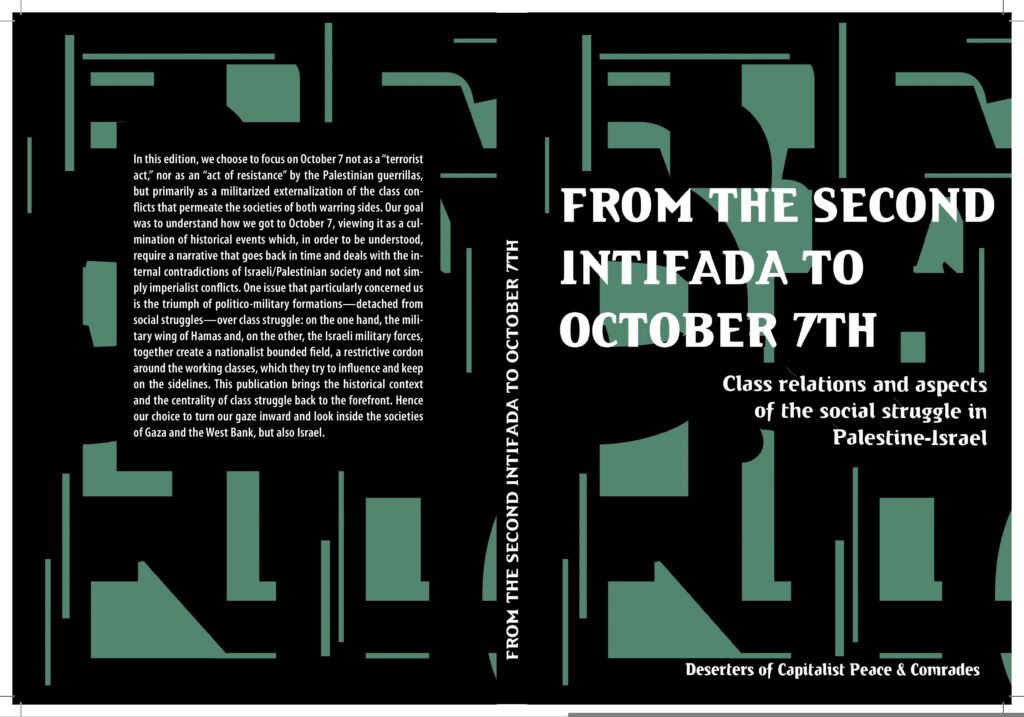
This edition was actually completed in August 2025, but it was not published until the end of September that year. Because of this, some parts of it are already out of date given where things stand today.
Despite the dishonest claims made by their defenders, the armed Palestinian resistance suffered a devastating defeat, one that came at the cost of hundreds of thousands of civilian proletarian lives, while leaving behind even greater numbers of mutilated and displaced people — alongside the near-total destruction of homes, hospitals, schools, energy infrastructure, and water supplies.
The result has been a sham ceasefire under which the destruction of the Palestinian proletariat in Gaza continues more quietly and with far less visibility.
Meanwhile, attacks by settler terrorists in the West Bank have reached unprecedented levels, with the Israeli state itself acting as the chief terrorist force, openly declaring its intention to annex the West Bank while continuing to approve new expansions of the illegal settlements there.
The same aggressive and militaristic logic of expansion and devastation is now being pursued in southern Lebanon, at the same time as military operations against Iran continue. For the foreseeable future, the Israeli state appears determined to remain locked in continuous warfare as a way of postponing the resolution of its own internal contradictions, along with the broader contradictions produced by the current crisis of global capitalist production.
May 2026
From the back cover
In this edition, we have chosen to focus on October 7 not as a “terrorist act,” nor as an “act of resistance” by Palestinian guerrillas, but primarily as a militarized externalization of the class conflicts running through both societies. Our aim has been to understand how October 7 came about, viewing it as the culmination of historical developments. To do so, we need a narrative that looks backward in time and brings to light the contradictions within Israeli and Palestinian societies, rather than framing the event merely as part of an imperialist conflict. A particular concern of ours has been the triumph of politico-military formations—detached from social struggles—over class struggle. On the one hand, the military wing of Hamas, and on the other, the Israeli armed forces, confine the working classes of both sides within narrow, suffocating nationalist frameworks designed to keep them out of the way. This brochure seeks to restore the centrality of class struggle and historical context to the forefront. Hence, we have decided to examine the internal dynamics of Gaza, the West Bank, and
Israel.